
Dryer Not Heating?
The Parts To Check, Gas And Electric
The drum turns, the timer counts down, the buzzer goes off, and the towels come out damp and cold. A dryer not heating has a break in 1 circuit, and gas and electric machines break that circuit in completely different places. Start with the fork, then work the chain, the same order our Baltimore techs use.
Hablamos Español
Since 2011 · 10,000+ repairs · 60-day warranty
Gas Or Electric?
Answer That First
A dryer is not heating when the drum turns normally and the air moving through it stays cold, and the cause is a failed part in the heat circuit or a vent so clogged that a safety device shut the heat off on purpose. Which parts are even candidates depends entirely on whether you own an electric dryer or a gas dryer, so that’s the first question our techs ask on the phone.
Look at the plug. Electric dryers take a fat 3 or 4 prong plug in a large round outlet, because they run on 240 volts. A normal household plug plus a yellow or black gas line running to a shutoff behind the machine means a gas dryer. Doctor Maintenance repairs both across Baltimore City and five surrounding counties, and a dryer with no heat is one of the most common calls we run.
Electric dryer
240 volts, two 30 amp breakers
A coiled heating element in a metal housing, usually behind or under the drum.
Where it usually fails- A blown thermal fuse, and thermal fuses never reset once they open
- A burnt open dryer heating element, often visible as a broken coil
- A failed high limit thermostat sitting on the element housing
- Half of a double breaker tripped, so the drum turns and the heat never comes on
Gas dryer
120 volts, one 15 amp breaker, plus a gas supply
A burner assembly: an igniter glows, a flame sensor confirms it, gas valve coils open the valve.
Where it usually fails- A cracked igniter that no longer glows
- A flame sensor that never closes its circuit, so the gas valve is never told to open
- Weak gas valve coils that open once and then quit part way through the cycle
- A closed shutoff at the wall, or gas supply turned off after other work
One thing is true of both machines. The motor circuit and the heat circuit are separate on Whirlpool, Maytag, LG and Samsung alike, so a dryer with a dead heating element or a dead burner still tumbles, still counts down, and still buzzes at the end. That’s why so many people describe the machine as working fine.
One Broken Link
Stops The Whole Chain
Dryer heat runs through a series chain of safety devices, and every link has to be closed before the last one gets power. Break any single link and the heat stops while everything else carries on. That’s the whole diagnosis in one sentence, and it’s why guessing at parts gets expensive fast.
Read the chain from the left and you have the order to test in. Power first, then the control that calls for heat, then the 2 safety devices, then the part that makes the heat. A technician walks it with a meter and gets a yes or no at every link.
A Clogged Dryer Vent
Is Usually The Real Fault
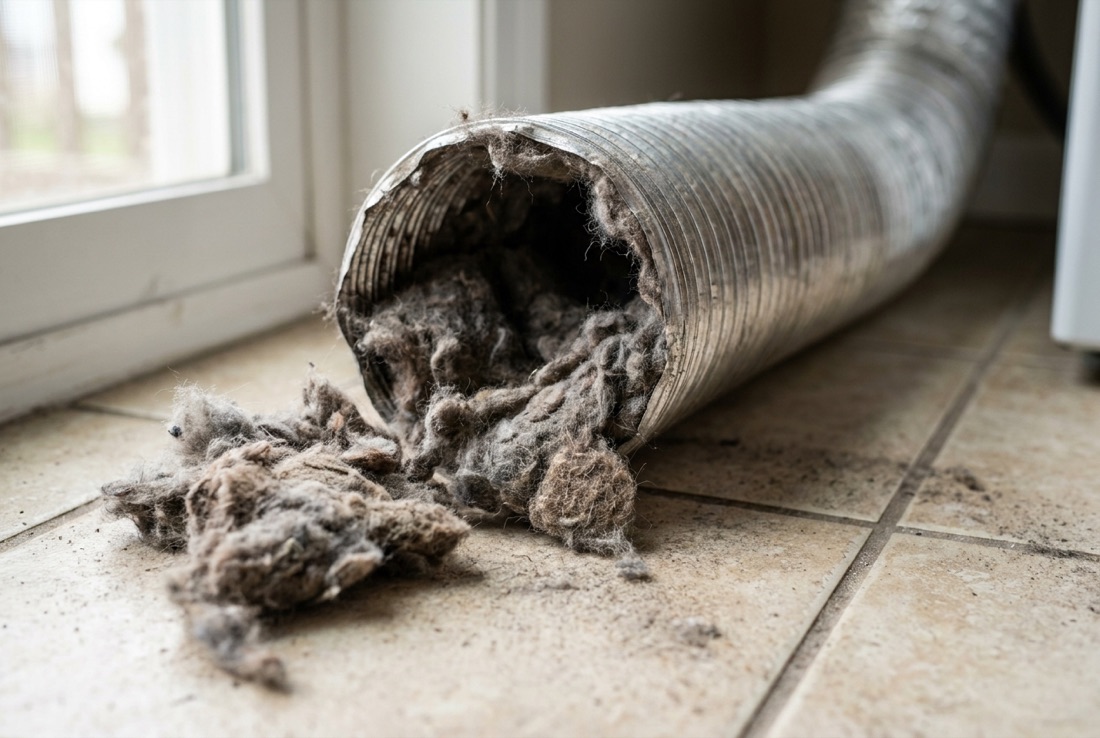
The most common reason for a dryer not heating is not a part at all. A thermal fuse is a safety device, so it does exactly what it was built to do and opens when the exhaust runs too hot. Air that can’t leave the drum is what makes the exhaust run too hot. So a blown thermal fuse is a symptom of a clogged dryer vent far more often than a part that simply wore out.
This is the single most expensive misunderstanding in dryer repair. Somebody replaces the fuse, the dryer heats for a week, the second fuse blows, and now there are 2 parts and 2 afternoons in a machine whose real problem is a duct full of lint. Vent cleaning is what fixes it, and it’s free if you do it yourself.
- Pull the lint screen and clean it every load. A screen coated in fabric softener film blocks air even when it looks clean, so wash it in hot soapy water 2 times a year.
- Unplug the dryer and pull the flexible hose off the back. Reach in with a vent brush or a shop vacuum and clear both the hose and the port on the dryer.
- Check the rigid duct inside the wall, especially on a long run through a Dundalk or Essex rowhouse basement where the duct can travel 20 feet or more.
- Go outside and open the exterior flap, then make sure it swings freely. Birds nest in them and lint mats behind them, so a stiff flap is a dead giveaway.
- Run a load with the exhaust hose off the back of the dryer. Heat with the hose off and none with it on tells you the vent is the fault and the dryer is fine.
A clothes dryer works by pushing hot air through the load and out of the house, so airflow is the job, and a vent cleaned once a year keeps it that way. A clogged vent takes that away first and the heat second. Clothes dryers start thousands of house fires a year in the United States, and failure to clean them is the leading cause, so clearing a clogged vent buys safety and drying performance at the same time.
The Seven Parts That
Stop A Dryer Heating
Each of these produces a slightly different story, and the story narrows the search before anybody opens the machine. Seven parts account for nearly every dryer not heating call we run, and the meter reading is what proves which one it is.
- Heating element
- The single most replaced part on an electric dryer that runs cold, and the first thing a dryer repair tech checks on an electric machine. The coil breaks open, resistance goes to infinity, and the drum turns with room temperature air moving through it, which is what a Whirlpool or Maytag owner usually describes as damp towels after a full cycle. A meter across the dryer heating element terminals settles it in seconds.
- Thermal fuse
- A one shot safety device wired in series with the heat circuit. It opens for good once the exhaust runs too hot and it never resets, so a blown thermal fuse means no heat at all on most electric models and a dead dryer on some. It’s the cheapest part on this list and the one most likely to come back, so a tech will test the thermal fuse with a meter, replace the thermal fuse, and then find the clogged vent that blew it.
- High limit thermostat
- Bolted to the heating element housing, the high limit thermostat cuts the element when the housing overheats. A failed one either sticks open, which kills the heat, or drifts, which gives you a dryer that warms up and then quits ten minutes into the cycle.
- Cycling thermostat
- The part that turns the heat on and off to hold the temperature you selected. When it fails open you get no heat, and when it drifts low you get a dryer that runs and runs on lukewarm air, which is what most people describe as a dryer taking too long to dry.
- Igniter (gas)
- A carbide element that glows orange to light the burner. A cracked igniter draws current for the full 30 or 40 seconds without ever reaching the temperature the burner needs, so it never lights. Watch through the burner inspection port: if it glows and no flame follows, the fault is downstream at the flame sensor or the gas valve.
- Flame sensor (gas)
- A small thermal switch beside the igniter that has to close before the gas valve coils are energized. When the flame sensor stays open the igniter glows on and on, gas never releases, and the dryer tumbles cold with everything else working.
- Gas valve coils
- Two or three coils that pull the gas valve open once the flame sensor confirms the igniter is hot. Weak coils are the classic intermittent: heat on the 1st cycle, nothing on the 2nd, and a homeowner who is sure the dryer is haunted.
A pattern worth carrying into the call: heat that never arrives points at an open circuit, and heat that arrives and then quits after 10 or 15 minutes points at a thermostat or a vent. Tell us which one you’re seeing when you book and the tech starts in the right half of the machine.
Tell Us What The Dryer Is Doing
Cold air, warm then cold, two cycles for one load: describe it and our support team follows up to confirm your weekday appointment, often within 48 hours.
- $100 for an expert visit and a full diagnosis
- Factory-certified techs, weekday appointments
- 60-day warranty, plus your $100 back if we find nothing wrong
- Hours
- Mon-Fri, 9am-5pm
- Service area
- Greater Baltimore and five surrounding counties, based in Dundalk
Prefer to book now? Schedule online or call (443) 678-8144.
What Actually Resets
A Dryer That Won’t Heat
Most dryers have no reset button, and the internet promises one anyway. The reset that matters lives at the electrical panel. An electric dryer runs on a 240 volt double breaker, and a double breaker can trip on one leg only, which leaves 120 volts feeding the motor and nothing feeding the heating element.
So switch the dryer breaker fully off, both halves together, wait 5 seconds, and switch it fully back on. A half tripped breaker often looks perfectly normal in the panel, which is exactly why this check gets skipped. On a gas dryer, confirm the shutoff valve behind the machine is open and in line with the pipe, because gas supply gets closed during other work and left that way.
- Some models carry a red thermal reset button on the high limit thermostat. Pressing it clears a one time trip and tells you nothing about why it tripped.
- A blown thermal fuse can’t be reset by anything. It’s a one way part, and it has to be replaced.
- Unplugging the dryer for 5 minutes clears the control board on newer LG and Samsung machines, which is worth one attempt after a power flicker.
- Check the power cord terminals if the dryer has been moved. A loose center wire on a 240 volt cord gives you a turning drum and no heat.
A reset clears the electronics. It never repairs a part.
Is It Worth Fixing A
Dryer That Won’t Heat?
Usually, yes. A dryer not heating is one of the cheaper faults to put right, because the parts that kill the heat are the inexpensive ones, and a dryer averages 10 to 13 years of service, so a machine in its first decade with a bad element or a blown thermal fuse is worth the repair by a wide margin. Our appliance repair vs replace guide walks the full math if you want the numbers next to your own machine's age.
The visit starts at $100, which buys an expert visit and a full diagnosis of the whole heat circuit, from the breaker to the burner. If a special order part is needed, our office prices it exactly and books the follow up, and you approve one flat repair price before any work happens. Every repair leaves with a 60-day warranty on parts and labor.
Find nothing wrong, and your $100 comes back.
Who you would be calling
We’ve been at this since 2011, more than 10,000 repairs across Baltimore City plus Baltimore, Anne Arundel, Harford, Howard and Carroll counties and Frederick, run out of our shop in Dundalk, with a 4.6 star average across 251 Google reviews. We’re factory certified for LG, GE, Dacor and Broan, and our guide to LG dryer error codes gives LG’s own first step for each one. Weekday appointments, Monday through Friday, often within 48 hours. When the dryer won’t spin, won’t start, or squeals while it runs, that is dryer repair of a different shape, and dryer repair in Baltimore is the page for it. If the washer beside it is misbehaving too, washing machine repair in Baltimore covers that half of the laundry room.
 60-second quiz
 Fix The Dryer, Or Replace It?
Answer eight quick questions about your dryer. We weigh the age, the problem, and the cost, then tell you whether a repair is worth your money.
Dryer Heat Questions,
Answered
Why is my dryer running but has no heat?
A dryer that runs with no heat has a break somewhere in its heat circuit, which is separate from the motor circuit that turns the drum. On an electric dryer the usual suspects are a blown thermal fuse, a burnt out heating element, a failed high limit thermostat, or half of the 240 volt double breaker tripped. On a gas dryer the burner is the place to look: the igniter, the flame sensor, or the gas valve coils. The drum keeps turning through all of it, which is why the machine seems fine.
How do you reset a dryer that won’t heat?
Most dryers have no reset button at all. The real reset is at the panel: switch both halves of the dryer circuit breaker fully off, wait a moment, then switch both back on, because a 240 volt double breaker can trip on one leg and leave the drum spinning with no heat. Some models carry a thermal reset button on the high limit thermostat, and a few gas models have one on the burner. A blown thermal fuse never resets and has to be replaced.
Is it worth fixing a dryer that doesn’t heat?
Usually yes, because the parts that stop the heat are the cheap ones. A thermal fuse, a heating element, a thermostat, an igniter or a flame sensor are all modest parts on a machine that averages 10 to 13 years of service, and a repair comes in far under the cost of a new dryer delivered and installed. The math turns the other way when a 12 year old dryer needs a motor or a drum bearing on top of the heat fault.
How do you fix a dryer that doesn’t get hot?
Start with the free checks, in this order: clean the lint screen, pull the exhaust hose off the back of the dryer and clear it, make sure both halves of the circuit breaker are on, and check that the gas shutoff is open on a gas dryer. Then run a load with the exhaust hose disconnected. Heat with the hose off and no heat with it on tells you the dryer vent is the problem. No heat either way means a part in the heat circuit has failed, and that needs a meter.
Can a clogged dryer vent stop a dryer from heating?
Yes, and it’s the most overlooked cause on the list. Lint buildup in the dryer vent traps hot air inside the cabinet, the exhaust temperature climbs, and the thermal fuse or the high limit thermostat opens exactly as designed to keep the machine from catching fire. The dryer then runs cold, and the fuse gets blamed for a vent problem. Replacing the fuse without clearing the vent just puts a new part in front of the same heat, so the second fuse blows too.
Why does my dryer keep blowing thermal fuses?
A thermal fuse that blows twice is reporting restricted airflow, not bad luck with parts. The fuse is a safety device that opens when the exhaust gets too hot, and the exhaust gets too hot when the air has nowhere to go. Check the full vent run: the lint screen, the flexible hose behind the dryer, the rigid duct inside the wall, and the flap on the outside of the house, which birds and lint both like to block.
Does a gas dryer need a 240 volt outlet?
No. A gas dryer plugs into an ordinary 120 volt outlet on a 15 amp breaker and gets its heat from the gas supply, which is why a gas dryer with a cold drum is almost never an electrical problem. An electric dryer needs 240 volts across a double breaker, and that difference is the reason the two machines fail in completely different places.
Why does my dryer take two cycles to dry?
Two cycles for one load points at airflow or a drifting thermostat rather than a total heat failure. A partly clogged dryer vent lets some air through, so clothes dry eventually and slowly. A cycling thermostat that opens too early has the same effect from the other direction. Clean the vent run first, because that fix is free and it’s also the one that prevents the next blown thermal fuse.
How do I know if the heating element is bad?
A bad dryer heating element usually shows a visible break in the coil once the rear panel is off, and a meter across its terminals reads open instead of the 8 to 15 ohms a healthy element gives. Some elements fail without a visible break, which is why the meter is the answer and a look is only a hint. Testing means pulling the back panel with the dryer unplugged, so it’s a job for someone comfortable around line voltage.
Is it safe to keep using a dryer that isn’t heating?
Running a clothes dryer with no heat wastes the cycle and can hide the real hazard underneath it. If a blown thermal fuse is what stopped the heat, the machine already ran hot enough to trip a safety device, and the restricted vent that caused it is a fire risk that hasn’t gone anywhere. Clothes dryers cause thousands of house fires a year, and failure to clean the vent is the leading cause. Stop using it and clear the vent.
How much does it cost to fix a dryer that isn’t heating?
A dryer heat repair starts at $100 for the visit and the full diagnosis, and if we find nothing wrong you get that $100 back. A standard repair with the part on hand comes to $225 total, one flat repair price that is almost always far less than a new dryer, and the $100 you paid to book is the first of those two payments rather than a charge on top. Special order parts get an exact quote from our office before any work begins, and every repair carries a 60-day warranty on parts and labor.
Book The Weekday
Dryer Visit
Tell us whether it is a gas or an electric dryer and what you already cleaned, and the tech starts where you stopped on the dryer not heating. You’ll have one flat price to approve before any work begins, and the full breakdown lives on our appliance repair cost in Baltimore page. Call or text if you’d rather talk it through first.