
Is It Worth Repairing
A Washing Machine?
Usually, yes. If your washer is under eight years old and the fix costs less than half the price of a new machine, repair wins. Here's how Doctor Maintenance runs that math on washing machines all over Baltimore: repair costs by failure type, honest lifespans, and the age where the answer flips to replace.
Hablamos Español
4.6★ from 251 Google reviews · 60-day warranty
Repair Wins More Often
Than People Expect
Is it worth repairing a washing machine? For most homes, yes. Most washer repairs land between $150 and $350, a comparable new machine runs $500 to $1,100 before delivery and hookups, and the average washer gives you about 10 years. Unless yours is deep into that lifespan or facing one of the few genuinely expensive problems, fixing it is the most cost effective option, and it usually saves several hundred dollars.
We've been repairing washing machines across Baltimore since 2011, more than 10,000 appliance repairs in all, and customers ask us this one at the kitchen door all the time. This post gives you the washer-specific numbers. For the decision on any other unit in the house, our full appliance repair vs replace guide walks the same factors for refrigerators through ovens.
The short version
- Washing machines last about 10 years on average, longer for top loaders.
- Common washer repairs run $150 to $350. A new appliance runs $500 to $1,100 plus delivery.
- Under half the price of new and under 8 years old? Repairing is the cost effective call.
- Belts, lid switches, valves, and drain pumps are almost always worth fixing.
- Bearings or a transmission on a machine past 10 years usually mean replace.
- A $100 diagnosis puts the exact repair number in front of you first.
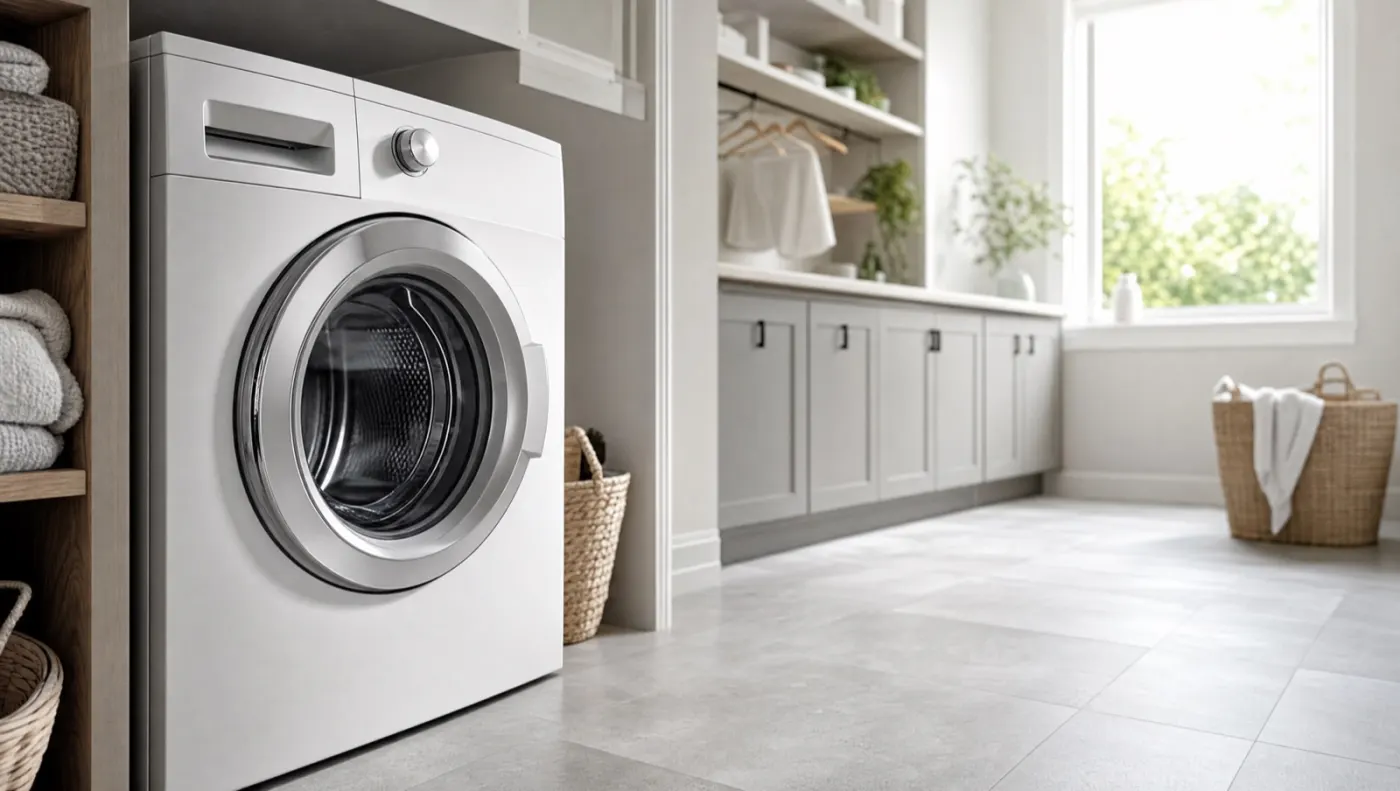
Most washer repairs cost less than half the price of new.
Washer Repair Costs
By Failure Type
The question really breaks into nine smaller ones, because the failure type sets the price. A faulty lid switch is pocket change next to worn drum bearings, so price the problem, not the machine. Here's how common washing machine repair costs compare, using national average ranges from industry cost guides. Guidance, not a quote for your machine.
| What failed | Typical repair range | The verdict |
|---|---|---|
| Lid switch or door lock | $85 to $180 | Worth fixing at almost any age |
| Drive belt | $100 to $200 | Worth fixing at almost any age |
| Drain pump | $150 to $300 | Worth fixing through year ten |
| Water inlet valve or timer | $125 to $250 | Worth fixing through year ten |
| Agitator, coupler, or clutch | $100 to $250 | Worth fixing on most top loaders |
| Drive motor | $200 to $400 | Worth it under year eight, then it depends |
| Control board | $250 to $500 | Newer and high-end machines only |
| Drum bearings | $350 to $550 | Newer front loaders, and it is a close call |
| Transmission | $300 to $500 | Usually replace past year ten |
Washer repair pricing reflects parts plus labor nationally. Your model, brand, and the part's availability move the number.
Fortunately, the minor failures are also the common ones. Belts stretch. Lid switches wear out. Drain pumps swallow socks and coins and quit draining mid cycle. That's the top of the table, and it's where most broken washing machines land. The big three at the bottom, bearings, the control board, and the transmission, are the only failures that regularly push a washer past the point where a new appliance makes more sense. On older machines the result is usually the same story: any of the big three ends it.
In Baltimore, our washer repairs begin at $100 for the visit and a complete diagnosis, and you approve one flat price before any work starts. Symptom-by-symptom detail lives on our washing machine repair in Baltimore page.
How Long Do
Washing Machines Last?
About 10 years. Consumer Reports member surveys keep landing near that mark, and what our technicians find in Baltimore homes agrees, from Dundalk rowhouses to newer builds out in White Marsh. Some washing machines quit at seven, plenty push past fifteen, and every one of them dies eventually.
Top loaders tend to outlast the average. The design is older and simpler, the agitator drivetrain is inexpensive to service, and 12 to 14 years isn't unusual. Older machines with mechanical timers are the simplest of all; the trade is fewer features and functions. Front-load models average closer to 8 to 11 years. They wash better and spin more water out of your clothes, but the bearings carry heavier loads, and bearings are the part that retires most of them.
Build quality stretches the curve at both ends. A Speed Queen is built like the machines in a laundromat and can run for decades with basic care, while bargain models might not see year eight. Habits matter too. A level machine, a clean drain filter, the right detergent: keeping up with the small stuff simply adds years. Overloading and harsh cleaning products shorten the life of any washer.
Where your machine sits on that curve is half the answer. The other half is what the washer repair costs.
 60-second quiz
 Run The Numbers On Your Washer
Answer eight quick questions about your washing machine. We weigh its age, the fault, and the repair cost against what a new one would run you.
The 50 Percent Rule,
With Washer Numbers
The 50 percent rule is the shortcut we give customers: if fixing your washer costs more than half the price of a comparable new washing machine, and the machine is past the midpoint of its expected lifespan, put the money toward the replacement. Under that line, repair it and don't look back.
Repair An $800 machine, a $220 drain pump swap, six years old. Compare the fix to the $400 halfway line and it's not close. You save $580 and keep a washer with a ton of life left. An easy yes.
Replace The same $800 machine at eleven years old needing $450 bearings. Past half, past the midpoint, past the point of sense.
Of course, both factors matter. A small fix on an older washer can still be worth it, and an expensive fix on a nearly new machine usually is too. The rule only says replace when the price is high and the machine is old at the same time, which keeps you from losing money at either extreme. When just one is true, it's a case by case call, and that's exactly where a diagnosis helps.
A $220 fix on an $800 washer isn't a close call.
Is It Worth Repairing A 5, 10,
Or 15 Year Old Washer?
Nobody searches for theory. People search their machine's age, so here are the brackets the way we'd explain them to a friend. Age is the loudest of the factors, but price still gets a vote.
Repair it. No debate. The machine holds most of its value, and any common fix is a good spend. Check the manufacturer's warranty first, because some brands still have major parts under warranty at this age.
Repair nearly everything. Belts, pumps, valves, switches, all easy math. Only bearings or a control board deserve a hard look, and even those often pass on high-end models, thanks to the higher replacement price.
The judgment zone. Small fixes still make sense, especially on top loaders, which age slower. The big three usually don't. This is where the 50 percent rule earns its keep.
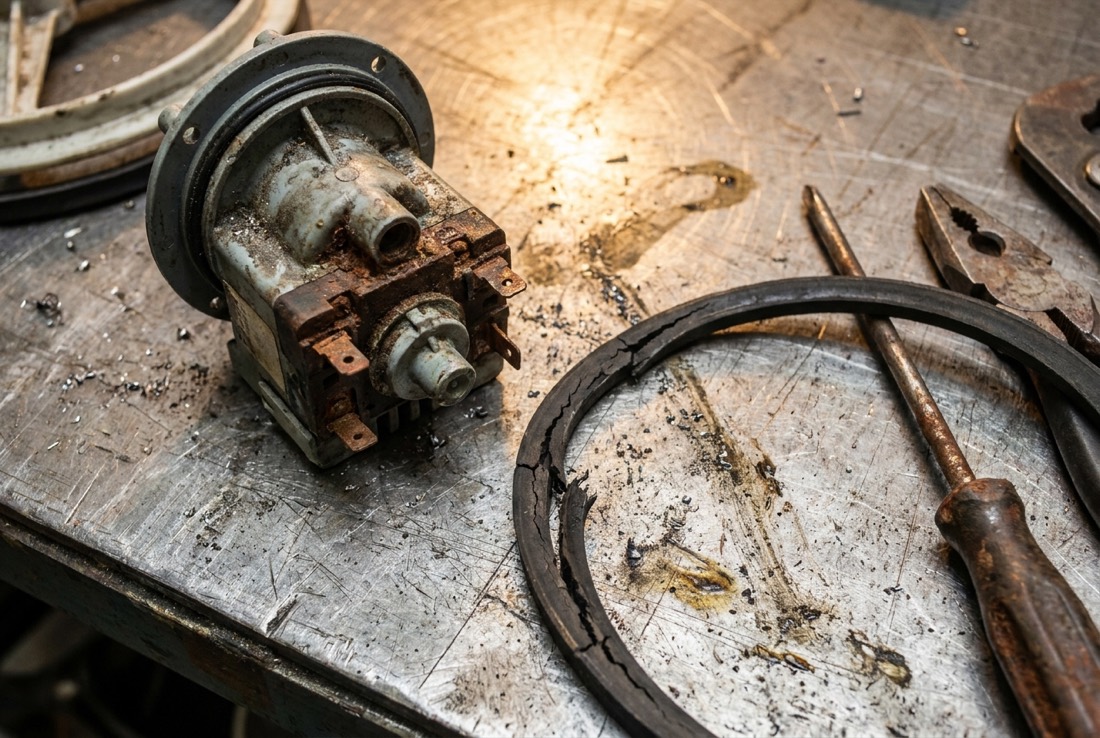
Replace on anything major. New parts in a machine that's simply worn out rarely pay off. The exception is a commercial-grade build, where even a rebuilt transmission on an older Speed Queen can make sense.
Past year twelve, big repairs stop making sense.
Should You Fix It Yourself
Or Call A Pro?
Some washer issues don't need us, and we'd rather you know which ones. If the symptom sounds familiar, you're handy, and you don't mind getting your hands wet, run this list before calling in a professional.
Fair DIY Territory
- Unplug it for a minute and turn it back on. You'd be surprised how many control issues clear on their own.
- Clean the drain filter. You'll find it behind a small door at the base, and the owner's manual shows exactly where. Coins, hair ties, and one lost sock leave it clogged, and a clogged filter explains a huge share of slow draining problems. Regular cleaning keeps it from coming back.
- Level the feet. A washer that walks or bangs on the spin cycle is often just sitting crooked.
- Check the water hoses. Tighten a loose hose clamp and look for kinks before assuming a broken pump.
- Wake up a lazy agitator on a top loader. One bolt under the cap holds it, and when that bolt works loose, the wash action fades. Tighten it down and the agitator usually comes back.
- Search your model number for a recall. Two minutes of research, and when a recall exists the fix is free.
Call A Repair Technician
- Anything that means removing the back panel, where water and electricity share close quarters. That's professional territory.
- Bearings. A YouTube video makes the job look like an afternoon. It's a full teardown of the drum, and one slip leaves the outer tub damaged for good. Watch one video all the way through and you'll see why.
- A drum that won't turn, or a clutch that won't engage. Motor and transmission work needs special tools, heavy lifting, and no room for guesswork.
- A faulty control panel, or a board that lights up while nothing else functions. Testing one the wrong way turns a $300 repair into a replacement.
- Gas or 240-volt connections anywhere on the laundry pair.
DIY has a natural border. If the fix is on the first list, go for it. Past that line, professional washing machine repair starts with a $100 diagnosis that takes the guesswork out, which beats a DIY fix that goes sideways and leaves the machine worse than it started.
Get The Real Number
Tell us the model info and what the machine's doing, and our support team follows up to confirm your weekday service appointment. A full diagnosis first, then one flat price to approve before any work.
- $100 for an expert visit and a full diagnosis
- Factory-certified techs, weekday appointments
- 60-day warranty, plus your $100 back if we find nothing wrong
- Hours
- Mon-Fri, 9am-5pm
- Service area
- Greater Baltimore and five surrounding counties, based in Dundalk
Prefer to book now? Schedule online or call (443) 678-8144.
When Does Replacing
Make More Sense?
Sometimes the honest advice from your repairman is to stop fixing and buy a new one. We tell customers to replace when a washer checks two or more of these boxes, because past that point every repair is throwing good money after bad.
- It's past 12 years old and facing one of the big three mentioned above, bearings, a transmission, or a control board.
- There's rust on the frame or a cracked outer tub. Corrosion only gets worse, and related issues follow it.
- It's broken again. A third service call in two years means the machine is failing as a system, not a part.
- Parts are discontinued. Some older models have been out of production so long that even good parts are hard to find.
- The quote tops half the price of a comparable new washer, and the machine is past its midpoint.
Energy efficiency alone rarely tips the decision, in our view. A newer washer trims water and energy use, which helps, but those savings are small next to the purchase price of a new appliance, so let the repair math lead and treat efficiency as a tiebreaker.
One more thing before the shopping trip: replacing the washer doesn't obligate the dryer. Dryers are simpler machines and routinely outlast washers, so before purchasing the matching laundry set, have yours looked at. Our dryer repair in Baltimore page covers what those fixes run.
And once you've decided to replace, price the new one online before you shop, then remember you don't have to pay full retail at the big-box retailers, where delivery, hookup, and haul-away pad the sticker. Choosing used keeps hundreds in your pocket, and we sell used appliances through the store side of our business. Call (443) 577-4661 and ask what's available before you buy a new one at full price.
How A $100 Diagnosis
Settles It
Rules of thumb get you close, and only close. The exact answer takes your machine's own numbers, and that's what the diagnostic visit provides. A repair technician diagnoses the washer in your home, in person, pins the problem down precisely, and hands you a real price instead of a guess from a search bar. That information beats any rule of thumb, and in our experience it's the most useful $100 in appliance repair.
Quick fix on the spot. If the problem is something simple, like leveling the machine, the visit price covers the whole thing. Nothing more.
Standard repair with the part on hand, finished that visit. The $100 you paid to book is the first of the two payments, and the total lands almost always far below the price of a new washer.
Special-order part. The office prices it, sends you an exact quote to approve, and we schedule the repair. No work happens until you say proceed.
Every repair is covered by a 60-day warranty on parts and labor. And if the smart answer is a replacement, we'll say so. We'd rather lose a repair than watch you spend against our advice. Service appointments are weekdays, 9am to 5pm, and the next available slot often lands within 48 hours, so a drum full of soaked clothes doesn't sit long. Send the form above, or call, either works.
If we find nothing wrong, your $100 comes back.
Repairing A Washing Machine,
Answered
Is it worth repairing a 5 year old washing machine?
Almost always, yes. A 5 year old washer sits in the first half of its expected lifespan, so nearly any common fix makes sense, from a $100 belt to a $300 drain pump. Check the manufacturer's warranty too, since some brands still cover major parts at that age. Replacing this early means losing years of value the machine still holds.
Is it worth repairing a 10 year old washing machine?
Sometimes. At 10 years old a washer has reached its average lifespan, so it depends on the repair price. A belt, lid switch, or drain pump under $250 can buy several more good years of service. Bearings, a control board, or a transmission at this age usually cost more than the machine is worth.
Is it worth repairing a 15 year old washing machine?
Rarely. A 15 year old washer is well past the average lifespan, and most of its parts are tired even if only one has failed. Of course we'd still fix something trivial like a lid switch, but anything over roughly $150 belongs toward a replacement. The exception is a machine built to commercial grade, like a Speed Queen, which can earn repairs for decades.
Is it worth repairing a 20 year old washing machine?
Usually not. Parts for older models this age are often discontinued, and a machine that old tends to fail somewhere new right after the first problem is fixed. A Speed Queen or similar commercial-style washer is the rare exception. For everything else, put the repair money toward purchasing the next machine.
Is it worth repairing a washing machine if the bearings have gone?
Only on a newer front loader, and even then it's a close call. Bearing jobs run $350 to $550 because the work means removing the whole drum, no matter how simple YouTube makes it look. On a machine under 5 years old the math can still work. Past 8 years, worn bearings are the clearest sign the washer is done.
When is it not worth repairing a washing machine?
When the repair tops half the price of a comparable new washer and the machine is past the midpoint of its life. Rust on the tub, repeated breakdowns, and discontinued parts all point the same way. In those cases a new appliance is the most cost effective option, and we'll tell you so after the diagnosis.
How much does it cost to fix a washing machine?
Most washer repairs land between $150 and $350 nationally, whether the repairman you hired is independent or a national chain. Simple fixes like a faulty lid switch or a belt run less, while motors, bearings, control boards, and transmissions run $200 to $550. With us, the visit and complete diagnosis begin at $100, and you approve one flat repair price before any work starts.
Is it worth repairing a Bosch, Samsung, or LG washing machine?
Usually, yes. Bosch, Samsung, and LG washers are worth fixing whenever the repair stays under half the replacement price, same as any brand, and parts are widely produced for all three. We're factory certified for LG, and our technicians work on Samsung, Bosch, Whirlpool, Maytag, Speed Queen, and every other major brand, with the same 60-day warranty on the work.
Should I replace my washer and dryer at the same time?
No, not unless both are broken. Dryers are simpler machines that routinely outlast washers, so a dying washer says nothing about the dryer sitting next to it. We understand the pull of a matching set, but paying $600 or more for symmetry is money thrown away. If only the washer is done, buy the new one and keep the dryer. Keeping the pair matched is an expensive habit.
How long do washing machines last?
About 10 years on average. Consumer Reports member surveys and industry data both land near that number. Top-load washing machines often run 12 to 14 years because the design is simpler, while front loaders average closer to 8 to 11. Care counts too, since a level, well-maintained washer with a clean drain filter outlasts one in rough condition.
Do you repair washing machines in my area?
If you're in the Baltimore area, yes. We handle washing machine repair across Baltimore City and County, plus Anne Arundel, Harford, Howard, and Carroll counties and out to Frederick. Service appointments are weekdays, 9am to 5pm, and the next available slot often lands within 48 hours. Booking online takes about two minutes, and calling works just as well.
What is the most expensive washing machine repair?
Drum bearings and the transmission top the list at $300 to $550 each, with control boards close behind. All three involve a major teardown or a costly part, which is why they trigger the 50 percent rule on older machines. The good news is that belts, switches, and valves fail far more often, and they cost a fraction as much.
Ready To Settle It?
Take the free repair-or-replace quiz before you're committed either way, or book a diagnosis and decide with your machine's real numbers. Either choice beats guessing. Full pricing detail lives on our appliance repair cost in Baltimore page, and everything we fix lives on the washing machine repair page.