
Refrigerator Not Cooling?
The Seven Causes, Ranked
Warm milk, soft butter, and a fridge that hums along like nothing’s wrong. Here’s the guide our techs wish every Baltimore homeowner had: the seven causes of a refrigerator not cooling, ranked from the free two minute fixes to the ones that end a fridge’s life, plus what’s safe to check yourself and how long your food will hold while you sort it out.
Hablamos Español
Since 2011 · 10,000+ repairs · 60-day warranty
The Likely Causes,
In Order
Seven causes explain nearly every refrigerator not cooling: bumped temperature settings, blocked air vents, dirty condenser coils, a worn door gasket, a dead evaporator fan, a defrost problem, or a failing compressor and sealed system, and that’s the order to check them in, free fixes before paid ones. We’re Doctor Maintenance, an appliance repair company serving Baltimore, MD since 2011, and the warm fridge is one of the most common issues our techs walk into.
Terms first. A refrigerator that is “not cooling” is one that can’t hold 40 degrees Fahrenheit or below in the fresh food section with the doors shut and the temperature controls set right. That 40 degree line comes from the FDA, and it’s the difference between keeping food fresh and quietly spoiling it. A worn gasket letting warm air in can sink a fridge just as surely as a dead fan.
- Check the temperature settings and clear the air vents first. Free, and they solve more warm fridges than you’d think.
- Dirty condenser coils are the top fixable cause our techs find. A vacuum with a brush attachment handles it.
- Freezer cold but fridge warm points to the evaporator fan, the defrost system, or the damper. Those are pro repairs.
- Above 40 degrees, your food has about a four hour window. Keep the doors closed.
- The $100 visit includes the full diagnosis, and if we find nothing wrong, you get the $100 back.
A warm fridge is a symptom. One of seven parts is the cause.

What Can Cause A Fridge
To Stop Being Cold?
Refrigeration is one loop. The compressor squeezes refrigerant, the condenser coils outside the box dump heat into your kitchen with help from the condenser fan, the evaporator coils inside get cold, and moving air carries that cold where it belongs. When any link in the chain slips, the box goes warm. Some links you can fix with your hands in ten minutes. Others take gauges, meters, and an EPA license.
Here’s the ranked list, from the causes you can clear before lunch to the ones that end the conversation. That’s the troubleshooting order our techs follow too.
| Likely cause | What you’ll notice | DIY or pro |
|---|---|---|
| Settings and airflow | Bumped temperature controls, blocked air vents, food items pressed against the back wall | DIY, minutes |
| Dirty condenser coils | Runs long and hot, the sides feel warm, weak cooling everywhere | DIY, 20 minutes |
| Worn door gasket | Door won’t snap shut, gaskets sweating, excessive condensation around loose door seals, ice buildup inside | DIY check |
| Evaporator fan | Freezer cold, fridge warm, squealing or humming from behind the back panel | Pro |
| Defrost problem | Frost climbing the freezer’s back wall, cooling fades and then returns | Pro |
| Stuck or broken air damper | Freezer perfect, fresh food section warm, no cold air from the vents | Pro |
| Compressor or sealed system | Silent, or clicking every few minutes, or running nonstop with no cold | Pro |
One pattern worth naming: the DIY causes starve the system of airflow, while the pro causes break the machine itself. If cleaning and clearing doesn’t move the needle, the fault is almost certainly mechanical or electrical. That’s professional territory, and it’s exactly what the diagnosis is for.
Six Safe Checks Before
You Call Anyone
All six are safe, free or nearly free, and require nothing more aggressive than warm soapy water and a vacuum with a brush attachment. Settings, airflow, coil cleaning, and a gasket check are homeowner territory. Wiring, motors, and the sealed system are not, so if a check points electrical, stop there and call a professional.
Set The Controls Right
Aim for a refrigerator temperature of 35 to 38 degrees and 0 in the freezer. On a 1 to 5 dial, the thermostat’s sweet spot is usually the middle, and refer to the owner’s manual for the maker’s recommendations if the dial is cryptic. Grocery bags and cleaning rags bump temperature controls more often than anyone admits. Give the box a full day to settle whenever the temperature settings change.
Clear The Air Vents
Cold air travels from the freezer through vents into the fridge. Pull items away from the vent openings and off the back wall, keep bags clear of the ice maker chute, and don’t pack shelves to the ceiling. A blocked vent chills nothing. Cool air needs a lane, and air flow dies the moment leftovers wall it off.
Vacuum The Condenser Coils
Unplug the unit. The condenser coils are usually accessible behind the base grille or around back, located down by the floor where dust settles. Remove the dust, pet hair, and other debris with a vacuum and brush attachment, and leave a couple inches of clearance behind the unit. Dirty condenser coils can’t shed heat, and heat that can’t be released means a box that can’t cool properly. Every six months keeps them honest, and the fridge at optimal performance.
Test The Door Gasket
Close the refrigerator door on a dollar bill. If it slides out easily with no drag, the gasket isn’t sealing, and warm air enters around the door seals every hour of the day. No fridge can cool properly against a steady leak of kitchen air. Wipe the gaskets down with warm soapy water, reseat them, and inspect for cracks or damaged corners. If you notice excessive condensation inside, the gasket’s usually the reason.
Confirm The Power
Look behind the unit: the plug seated in the outlet, the circuit breaker not tripped. Flip a tripped breaker back once, and if it keeps tripping, leave it off and call. Interior lights being on doesn’t clear the cooling side, they operate on separate circuits.
Stop And Listen
With the unit plugged in, stand by the fridge for two minutes. A healthy compressor hums low and steady. Silence, buzzing, or a click every few minutes from the start relay is your answer: the problem’s electrical, and it’s professional territory. Tell us what you hear when you book, that information saves diagnostic time.
Across Dundalk rowhouses and Towson colonials, those six troubleshooting checks close out a meaningful share of the warm-fridge service calls we see, coil cleanings most of all. Twenty minutes, zero parts, and the same tips we give family.
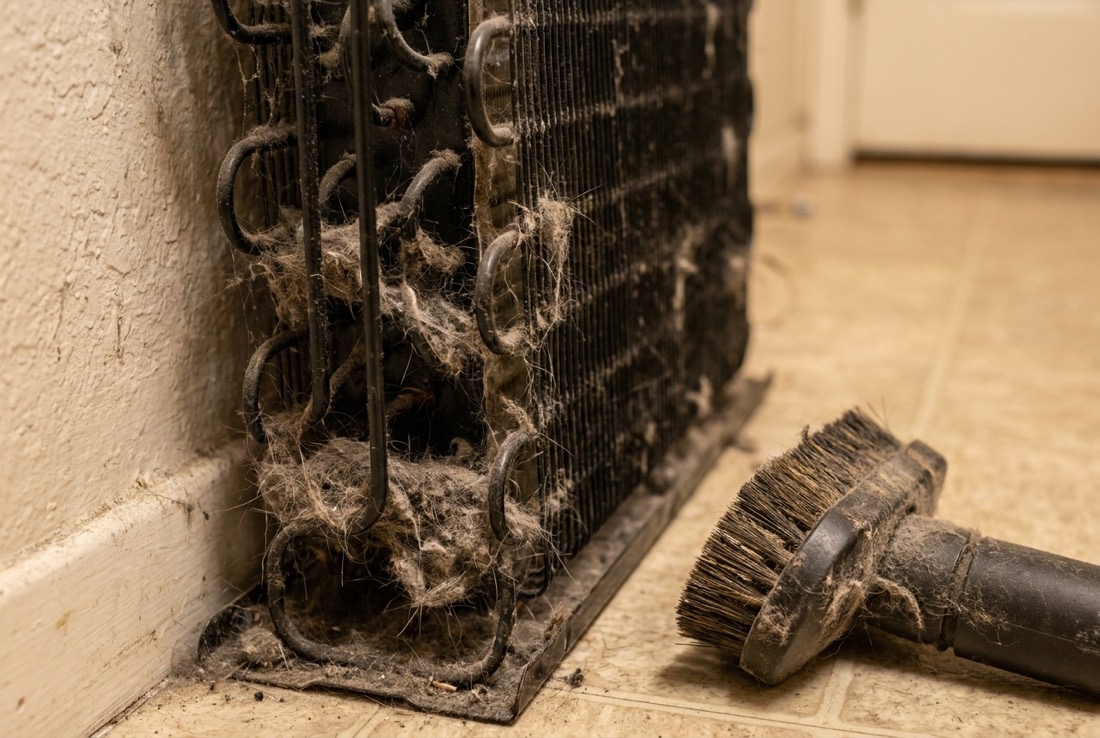
Check the simple stuff first. Let a pro chase the rest.
Why Is The Freezer Working
But The Fridge Warm?
This one gets its own section because it’s the single most searched version of the problem. When the refrigerator is not cooling but the freezer is working, the cooling system itself is usually fine. The cold is being made. It’s just not arriving.
To understand the split, follow the cold. Most household refrigerators make all their cold in the freezer compartment. The evaporator coils, located behind the freezer’s back panel, chill that space, the evaporator fan pulls air across them, and a damper meters how much of that cold air enters the fresh food section through the air vents. Three parts, one job: move cold from where it’s made to where the milk lives.
Three reasons cover it. A dead evaporator fan is the loudest suspect, often literally, since a failing motor squeals or grinds before it quits. A defrost malfunction is sneakier: the defrost heater, the defrost thermostat, or a faulty defrost timer typically stops the defrost cycle from clearing frost, ice buildup swallows the evaporator coils, and airflow chokes off slowly over a week, with less and less cold air reaching the shelves below. And a stuck damper simply never opens the gate, so the freezer hoards every degree of cold while the fridge side starves.
If the freezer’s struggling too, the diagnosis shifts toward the shared machinery underneath both compartments: the compressor, the condenser fan, or the sealed system. And when the freezer alone stops freezing, that’s a different set of common issues, ranked in our guide to a freezer not freezing and handled by our freezer repair in Baltimore team.
Does Unplugging A Fridge
Reset It?
Short answer: unplugging clears the brain, not the body. Five to ten minutes off power resets the control board, wipes most error codes, and frees up a locked control panel. For a fridge acting glitchy after a power outage, it’s a good first move before anything else.
What a reset won’t do is repair hardware. There’s no reset button for the refrigerator’s compressor on most models, and pulling the plug won’t unstick a damper, spin a dead fan, top off refrigerant, or clean your condenser coils. After you plug back in, give it up to 24 hours to stabilize. A fridge thermometer takes the guessing out, watch for a steady temperature drop toward 37 degrees. If it still won’t cool properly after a full day, the problem was never electronic.
Two sounds worth knowing while you wait. Rhythmic clicking with no cooling is usually a faulty start relay trying to launch the compressor and losing. A compressor running nonstop with no cold to show for it is the other bad sign. Newer refrigerators from Samsung, LG, and others run on inverter technology and start softer and quieter, so on those models silence tells you less. Either way, if a reset doesn’t hold, the fix is mechanical.
A reset treats the symptom. A diagnosis finds the cause.
How Long Is
Your Food Safe?
While you troubleshoot, the groceries are on a timer. FDA guidance gives perishable food about four hours once the temperature passes 40 degrees before it’s no longer safe, and that window includes every minute spent standing there with the refrigerator door hanging open, staring at the shelves.
So work the checklist with the doors shut as much as you can. A full freezer protects itself for roughly 48 hours, about 24 if it’s half full, provided the freezer door stays closed. Move high risk food items like milk, meat, and leftovers to a cooler with ice if the fresh food section has already gone warm. When in doubt, throw it out.
Losing a fridge full of groceries stings twice, once at the trash can and again at the store, and it’s always more food than you thought. It’s the quiet argument for booking the repair the same week instead of nursing a dying unit along.
Past 40 degrees, the clock on your food is already running.
Tell Us What The Fridge Is Doing
Warm shelves, clicking, frost on the back wall: describe what you’re seeing and our support team follows up to confirm your weekday appointment, often within 48 hours.
- $100 for an expert visit and a full diagnosis
- Factory-certified techs, weekday appointments
- 60-day warranty, plus your $100 back if we find nothing wrong
- Hours
- Mon-Fri, 9am-5pm
- Service area
- Greater Baltimore and five surrounding counties, based in Dundalk
Prefer to book now? Schedule online or call (443) 678-8144.
When It Needs The
$100 Diagnosis
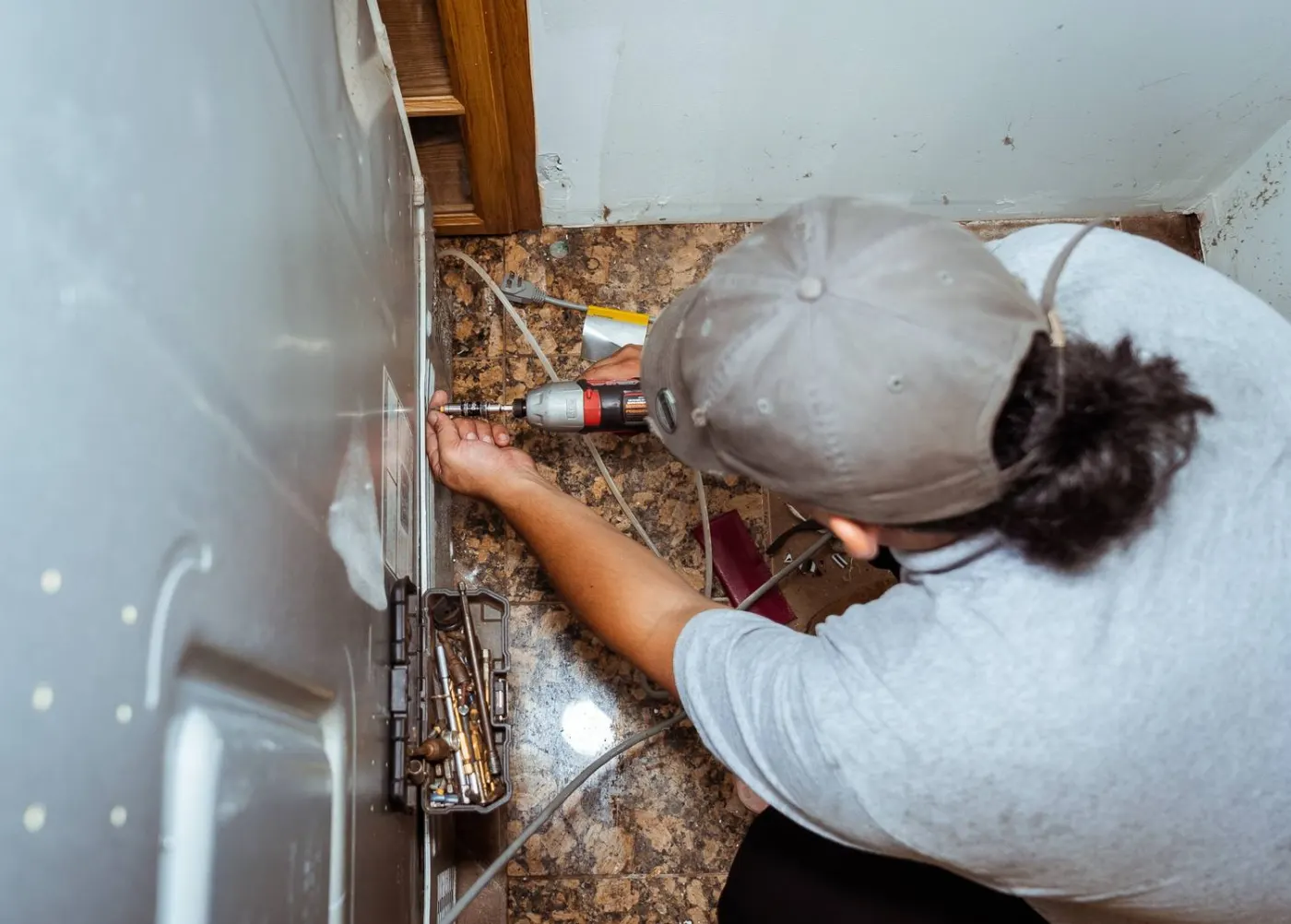
Everything past the checklist, the evaporator fan, the defrost system, the damper, the start relay, a refrigerant leak in the sealed system, calls for a meter, a manual, and someone who’s done it a thousand times. A refrigerator’s compressor usually drops hints before it dies, and reading those hints is the skill. Guessing with parts is how a $40 relay turns into a $400 experiment.
Here’s how we handle it. The visit starts at $100, which covers a full diagnosis, not a glance and a shrug. The technician inspects the whole cooling loop, determines the real cause, and if a special order part is needed, the office prices it exactly and books the follow-up. You approve one flat repair price before any work happens, and every repair leaves with a 60-day warranty on parts and labor.
Find nothing wrong, and your $100 comes back.
We’ve been at this since 2011, more than 10,000 appliance repairs across Baltimore and the five surrounding counties, run from our shop in Dundalk, with a 4.6 star average across 251 Google reviews. We’re also factory certified for LG, GE, Dacor, and Broan, which matters on cooling work because factory parts and factory procedures are the difference on those brands. An LG fridge losing its chill has its own page: LG appliance repair. For everything else refrigerator shaped, from ice maker faults to door gaskets, start with refrigerator repair in Baltimore, MD.
Wondering whether a fridge this age deserves the fix at all? Run your numbers through our appliance repair vs replace guide, or take the one minute repair-or-replace quiz for a quick read.
¿Prefiere leer en español? Nuestra guía de reparación de refrigeradores en Baltimore cubre precios, garantía y citas entre semana.
 60-second quiz
 Fix The Fridge, Or Replace It?
Eight quick questions about your refrigerator, and we will tell you whether the repair is worth it. Its age, the fault, and the cost all go into the answer.
Refrigerator Not Cooling,
Answered
Why is my refrigerator not cooling but the freezer is working?
The evaporator fan, the defrost system, or the air damper is the usual culprit. Most refrigerators make all their cold in the freezer, then a fan pushes that cool air through a damper into the fresh food section. If the fan dies, the evaporator coils ice over, or the damper sticks shut, the freezer stays cold while the fridge side slowly goes warm. All three are repairs for a technician. The ice maker usually keeps working through all of this, which fools people into waiting.
Why is my refrigerator not cooling but the light is on?
Power isn’t your problem. The interior lights operate on a separate circuit from the cooling side, so a lit fridge that won’t chill points to the compressor, the start relay, the thermostat, or airflow. Listen for the compressor: a steady hum means it’s trying. If you hear silence or rhythmic clicking instead, the start relay or the compressor itself needs attention.
What is the most common cause of a fridge not cooling?
Dirty condenser coils lead the list on the calls we run. The coils shed the heat pulled out of the box, and once they’re wrapped in dust and pet hair the refrigerator can’t cool properly no matter how hard the compressor works. Bumped temperature controls and blocked air vents round out the top three, and all three are the easiest fixes on the list.
How do I reset a refrigerator compressor?
Resetting a refrigerator compressor isn't done with a button on most models. Check the manual first, a few models do have one. Otherwise, unplug the unit, wait five to ten minutes so the control board clears, then plug it back in. If the compressor was held back by an error code or a locked control panel, that can wake it up. If it was failing mechanically, no reset will bring it back.
Will unplugging the refrigerator reset it?
Unplugging resets the electronics, not the machinery. Five to ten minutes off power clears most control boards, and it’s worth trying after a power outage or a glitchy display. Give the unit up to 24 hours afterward to pull back down to a stable temperature before you judge the result.
Should a fridge be set on 1 or 5?
The middle of the dial is the right starting point on most models where the controls run 1 to 5, with 1 warmest and 5 coldest. What you actually want is a refrigerator temperature between 35 and 38 degrees in the fresh food section and 0 in the freezer. Cranking the dial to 5 doesn’t speed anything up, it just makes the unit run longer.
What should I check first when the refrigerator is not cooling?
Settings and power are the first step. Make sure the unit is plugged in snug, the circuit breaker hasn’t tripped, and nobody bumped the temperature settings. Then clear the air vents inside, pull the unit a few inches off the wall, and vacuum the condenser coils. Those checks close out a real share of warm-fridge calls before anyone touches a tool.
Why is my refrigerator not cooling after a power outage?
Give it 24 hours before you worry. A refrigerator that sat warm needs a full day of steady running and several compressor cycles to pull the whole box back down. If it’s made no progress after that, check for a tripped circuit breaker, a locked control panel, and error codes, then unplug it for ten minutes to clear the electronics. Still warm after all that? It’s a deeper malfunction, and it’s time to book the diagnosis.
Why is my fridge clicking and not cooling?
Clicking every two to five minutes is the classic sound of a start relay trying and failing to kick the compressor on. Sometimes the relay itself has died, which is a modest repair. Sometimes the compressor is seizing, which is a bigger conversation. Either way it’s electrical work for a professional, and worth booking before the compressor takes more abuse.
How long will food stay safe in a refrigerator that is not cooling?
About four hours, per FDA guidance, as long as the refrigerator door stays closed. After that, perishable food items like milk, meat, and leftovers that sat above 40 degrees belong in a cooler with ice or in the trash. A full freezer holds a safe temperature for roughly 48 hours if the freezer door stays shut, which buys you time to get the repair booked.
Is it worth fixing a refrigerator that is not cooling?
Usually, yes. Most cooling failures come down to one worn part, a fan motor, a relay, a gasket, a defrost component, and repairs like these typically run a fraction of the $600 to $2,300 a new fridge costs once it’s delivered and installed. A seven year old refrigerator is barely past the midpoint of its 13 year average lifespan. The main exception is a failed sealed system on an old unit, where the smart money often goes to replacement. Our appliance repair vs replace guide walks the full math.
Why is my LG refrigerator not cooling?
LG built many of its refrigerators around a linear compressor, and a weakening one is a well documented cause of gradual cooling loss on those models. The fix calls for factory parts and factory procedures. We’re factory certified for LG, so an LG fridge that’s losing its chill is squarely in our lane, and the same team covers GE, Samsung, Whirlpool, and the rest.
How much does it cost to fix a refrigerator that is not cooling?
Fixing a refrigerator that isn't cooling starts at $100 for the visit and the full diagnosis, and if we find nothing wrong you get that $100 back. A standard repair with the part on hand runs $225 total, finished that visit, and the $100 you paid to book is the first part of that number, never extra on top. Special order parts get an exact quote from the office before any work, every repair carries a 60-day warranty on parts and labor, and either way you’re almost always far below the cost of a new fridge.
Get The Refrigerator
Cooling Again
Book the weekday visit, show the tech what you found, and get one flat price before any work starts. Want to learn what repairs run first? The full breakdown lives on our appliance repair cost in Baltimore page. Or call or text with questions, because a two minute conversation beats a week of guessing.