
Garbage Disposal Humming
But Not Spinning?
Here's the answer up front: a garbage disposal humming but not spinning is receiving power, but the flywheel inside can't turn. Usually that's a jam. Sometimes it's a seized motor. Either way, don't hit the switch again until you've read the safe sequence below, because the hum is the sound of a motor hurting itself. Doctor Maintenance repairs appliances all over Baltimore, MD, and a stuck disposal unit is one of the most common garbage disposal issues we get asked about. This guide covers what the humming noise means, the five safe steps, and when to put the wrench down.
Hablamos Español
Since 2011 · 10,000+ repairs · 60-day warranty
What Is That Humming Noise
Telling You?
The short version
- The humming noise means electricity is reaching the motor, but the flywheel can't turn.
- Cut power at the wall switch and the breaker before anything else.
- Never put your hand or a utensil in the grinding chamber.
- An allen wrench in the hex socket at the bottom frees most jams.
- The reset button restores a motor that overheated and tripped.
- Still humming after both? That's likely a seized motor. Book a diagnosis.
A humming garbage disposal is a unit that's receiving power while its grinding plate can't move: the motor is energized and pushing, but a stuck flywheel is holding everything still. The flywheel is the spinning plate at the bottom of the grinding chamber, and when a fruit pit or a stray bottle cap gets lodged between it and the chamber wall, the whole works locks up. The motor keeps trying anyway. That strain is the humming sound you're hearing.
People blame dull blades, but a disposal doesn't have blades at all. It grinds with two blunt metal lugs on that spinning plate, flinging food scraps against a shredder ring, so there's nothing to sharpen and nothing to dull. It's a common problem with a short list of causes: when a disposal stops grinding, something is stuck, something tripped, or the motor is dying. The sound tells you which road you're on.
The hum is power with nowhere to go.
Match The Sound
To The Cause
A disposal only makes a handful of sounds, and each one narrows the source of the trouble. When a garbage disposal is humming, the fault is typically caused by a jammed flywheel. Silence with a dead switch is an electrical issue, usually a tripped breaker. A metal rattle means a foreign object is loose in the chamber. Before attempting any fix, match the symptom to the chart and note the safe next steps.
| What you hear | Likely cause | Safe next step |
|---|---|---|
| Steady humming sound, nothing turns | An obstruction has the flywheel jammed | Cut power, crank the hex socket free |
| Hum that clicks off after a few seconds | Overload protecting an overheated motor | Power off, let it cool, press the reset button |
| Hum plus water backing up in the sink | A jam and a clogged drain line together | Power off; the drain needs clearing too |
| No sound at all, dead switch | Tripped breaker, tripped GFCI outlet, or a faulty switch | Check the breaker and the outlet reset |
| Hum that survives the crank and the reset | Seized motor bearing or faulty motor | Stop and call a professional |
| Metal rattle while it runs | A loose foreign object batted around the chamber | Power off, flashlight, tongs or pliers |
Every fix in this chart begins with the power cut at the switch and the circuit breaker.
One distinction worth keeping straight: a jam stops the flywheel, a clog stops the water. If the unit spins fine but the sink backs up, you've got a clogged drain line, and a blockage deep in the pipes past the trap is a professional plumber's job. The two problems do love to travel together, though. Most dishwashers drain through the disposal, so a blocked unit can push dirty water backward, and food particles that settle in the shared line slow both appliances. When they fail the same week, dishwasher repair in Baltimore and a disposal fix often turn out to be one appointment.
How To Unjam It
Without Losing A Finger
These five DIY troubleshooting steps are the only ones worth attempting on a humming unit, and the most important of the five is the first. Follow the troubleshooting steps in order, because the order is the safety. The whole fix is two real actions, the crank and the reset, with nothing to take apart. If you remember nothing else, remember that clearing a jam starts with power, not tools.
- 1
Cut The Power. Twice.
Cutting the disposal's power is the crucial move, and it happens in two places. Flip the wall switch off, then flip the circuit breaker at the main breaker box. Switches fail, and so does wiring, so trust neither. If the unit plugs in under the sink, unplug it too, and check whether that outlet is a GFCI outlet; a tripped one explains a disposal that's silent instead of humming. Nothing below happens while the motor is receiving power.
- 2
Look, Don't Reach
Shine a flashlight down the drain opening and inspect. You're checking for visible blockages only: fruit pits, bones, a bottle cap, a twist tie, or other debris sitting where you can see it. If the culprit is visible, lift it out with tongs or needle-nose pliers. Never put your hand in the grinding chamber, even with the power off, even for a second. And skip the wooden spoon and broom handle tricks, because prying at the plate from above cracks more than it clears.
- 3
Crank The Flywheel From Below
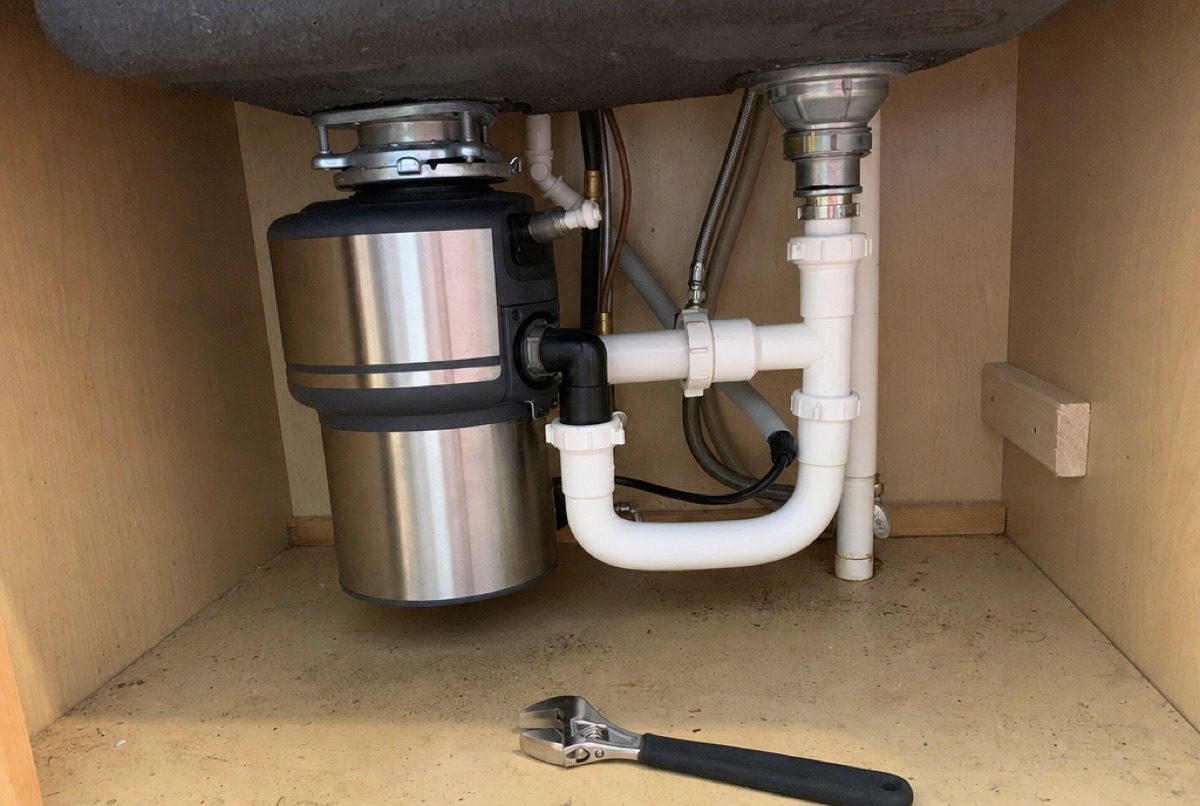
Under the sink, locate the hex-shaped hole dead center on the bottom of the unit. Insert a quarter-inch allen wrench, or the little offset wrench that ships taped to many disposals, and work it back and forth to dislodge the jam. You're using leverage to manually rotate the flywheel, which is easier than it sounds. Expect stiff resistance, then a sudden give. You'll feel it let go. Keep cranking full circles until it spins freely both ways.
- 4
Press The Red Reset Button
It lives on the bottom of the unit too, a small red button near the hex socket that pops out when motor overheating trips the overload. If the disposal hummed a while before you shut it off, the motor's hot. Wait 10 to 15 minutes, allowing it to cool, then press the reset button until it clicks and stays in.
- 5
Restore Power And Test
Breaker on, switch ready, cold water running. Test in short bursts of a few seconds. If it roars back to life, let the water run another 20 seconds to flush the loosened food particles and debris down the drain line. That resolves it in most kitchens. If the disposal is still humming, or hums and trips the reset again, stop. You've done everything a homeowner safely can, and the next move is to call a professional.
No hand goes in that chamber. Ever.
 60-second quiz
 Worth Fixing, Or Time For A New One?
Eight quick questions about your disposal. Its age, the fault, and the repair cost go in, and a plain recommendation comes out.
Can You Run A Disposal
While It's Humming?
No. Running it to finish the dishes makes the jam worse, and so does jiggling the switch or trying short bursts. While the garbage disposal is humming, the motor is stalled at its full current draw, and the result is all that electricity becoming heat in one small place. Hold the switch and you're not grinding through the jam. You're cooking a motor that costs real money, and each round of humming does further damage. The overload system is essential protection, clicking off to save the motor, but it's a circuit, not a miracle, and a stalled unit left humming is genuinely hazardous to itself and the wiring behind it.
Two myths deserve a quick burial. Running cold water and a handful of ice cubes keeps a healthy grinding chamber clean, but ice does nothing for a stuck flywheel, and it can't sharpen blades that don't exist. And if you own a batch feed disposal, the kind that only runs with the stopper locked in position, don't defeat that design to force it. The stopper is there for the same safety reason your hand stays out of the drain opening.
Sixty seconds of stubbornness can turn a bottle-cap jam into a dead motor.
What If It Still Hums
After The Reset?
Say you did everything right. Power cycled at the circuit breaker, flywheel cranked until it spins freely, reset button pressed, and the unit still hums or clicks back off within seconds. The jam theory is dead. What's left is the motor: a seized motor bearing, failed start parts, or a faulty motor with cooked windings. Rust does the same quiet work on disposals that sit unused for months. In rare cases the fault sits upstream instead, in a faulty switch or loose connections in the wiring, and that's where professional help beats persistence, not a place to probe on your own.
This is where the repair-or-replace question shows up, and honestly, the disposal may be the easiest appliance in the house to call. A unit near the 10-year mark with a failing motor usually isn't worth a motor swap, and sometimes the straight answer is an upgrade to a new one. A newer unit, or one whose real problem turns out smaller than it sounded, is often worth investigating before you shop for a replacement. Our repair vs replace guide runs the full math, and the repair-or-replace quiz gets you an answer in about a minute.
Or skip the guessing. A garbage disposal repair in Baltimore visit starts at $100, which covers the trip and a complete diagnosis of what's causing the hum, from our Dundalk shop to homes across Baltimore and five surrounding counties. The tech diagnoses on site, shows up equipped for a verdict, no sales pitch attached, and some fixes happen on the spot with the $100 as the whole bill. You approve one flat price before any work begins, special-order parts get an exact quote from our office first, and every repair is backed by a 60-day warranty. You're paying for the expertise, not the clock. Appointments are weekdays, with the next available often within 48 hours, and if we find nothing wrong, the $100 comes back to you.
A hum that survives the reset isn't a jam. It's a verdict.
How Do You Keep A Disposal
From Jamming Again?
Most jams are self-inflicted, which is good news, because it means most jams are preventable. The unit isn't prone to failure on its own; it fails on the food items it was never built to grind and the food scraps shoved through too fast. The common causes of a jam are all diet, so two short lists cover nearly everything.
Keep It Out Of The Disposal
- Grease and fats, which build up in the pipes and lead to a clogged drain line.
- Fibrous foods like corn husks and celery, whose strings wrap the flywheel.
- Fruit pits, bones, and popcorn kernels, the classic jam culprits.
- Potato peels in bulk, which pack into a paste the lugs can't move.
- Foreign objects that were never food: bottle caps, twist ties, the odd teaspoon.
Habits That Keep It Running Smoothly
- Run cold water before every grind, and follow each one with 20 more seconds of it.
- Feed food waste in small batches, never one big push.
- Grind a few ice cubes with cold water every couple of weeks; it cleans the lugs that pass for blades and helps flush the chamber.
- Small strips of citrus peels freshen the chamber; skip whole rinds.
- Use a batch feed model's stopper as designed. It's a safety feature, not a suggestion.
A disposal is easy to maintain: running cold water is most of the secret, since it keeps grease solid enough to chop and flush before it can coat the pipes. That's the whole program for keeping the unit in working order for years. One warning to file away: if the unit ever leaks from the bottom seam, stop using it, because bottom leaks usually mean the internal seal has failed, and that's a replacement conversation.
The cheapest fix is the jam that never happens.
Let A Tech Take It From Here
Tell us what the disposal's doing and our support team follows up to confirm your weekday appointment. It starts at $100 for the visit and a full diagnosis, and if we find nothing wrong, you get the $100 back.
- $100 for an expert visit and a full diagnosis
- Factory-certified techs, weekday appointments
- 60-day warranty, plus your $100 back if we find nothing wrong
- Hours
- Mon-Fri, 9am-5pm
- Service area
- Greater Baltimore and five surrounding counties, based in Dundalk
Prefer to book now? Schedule online or call (443) 678-8144.
Humming Disposal Questions,
Answered
Why is my garbage disposal humming but not spinning?
The humming sound means the motor's receiving power but the flywheel can't turn, and in most homes the cause is a jam: a fruit pit, a bone, a bottle cap, or packed food waste lodged between the grinding plate and the chamber wall. Cut power at the switch and breaker, then free the flywheel with an allen wrench in the hex socket at the bottom of the unit. If it spins freely and still only hums, the motor itself is the likely culprit.
How do I fix a humming garbage disposal myself?
Two moves fix most humming disposals. First, with power cut at the switch and the circuit breaker (unplug the cord under the sink if it has one), insert a hex wrench into the socket at the bottom of the unit and work it back and forth to free the stuck flywheel. Second, press the red reset button, also on the bottom, if it's popped out. Restore power, run cold water, and test in short bursts. If the disposal is still humming after both, stop and call a professional.
How do I unjam my garbage disposal?
The hex socket at the bottom of the unit is the safe way in. Kill the disposal's power at the switch and breaker, slide a quarter-inch allen key into the socket, and crank back and forth until the flywheel spins freely a full turn. Then shine a flashlight down the drain opening and lift out whatever you dislodged with tongs, never fingers. That clears the obstruction in the vast majority of jams without taking anything apart.
Is it safe to use a humming disposal?
No. Operating a humming disposal means holding a stalled motor at full current, and every second turns into heat inside the windings. You won't grind the jam loose. You'll cook the motor or trip the overload again. In that situation the only safe move is cutting power, then clearing the jam through the hex socket or getting professional help to do it.
How do I reset my garbage disposal when it just hums?
The red reset button sits on the bottom of the unit, usually near the center. It pops out when the overload trips. Give the motor 10 to 15 minutes to cool, press the button until it clicks and stays in, then test with cold water on. If the problem persists past a second reset, the flywheel is still stuck or the motor is failing, so stop there.
What if my garbage disposal is humming but not spinning and not jammed?
A hum with a flywheel that turns freely points to the motor itself: a seized motor bearing, failed start parts, or a motor malfunction from windings that overheated once too often. Rust can freeze a unit that sat unused for months, too. That's not a homeowner fix. A diagnosis tells you whether the repair is worth it or the smarter spend is a new disposal.
Can a garbage disposal motor burn out?
Yes. Running a jammed disposal is the fastest way to do it, because a stalled motor pulls maximum current and turns all of it into heat. The overload system trips to protect it, but repeated humming sessions lead to cooked insulation on the windings. Once a motor truly burns out, it doesn't come back.
How do I know if my garbage disposal motor is bad?
The tell is a hum that survives the full sequence: power cycled, flywheel cranked free with the hex wrench, reset button pressed, and the unit still hums or trips within seconds. A burning smell, or a breaker that trips every time you flip the switch, are signs of the same electrical issue. At that point you're looking at a faulty motor, not a jam.
Is it okay to spray WD-40 in a garbage disposal?
We don't recommend it. WD-40 won't free a mechanical jam the way the hex socket will, and a petroleum product has no business in a chamber that handles food. If the flywheel is so seized that you're reaching for spray instead of the hex key, the unit needs a diagnosis, not a lubricant.
What's the life expectancy of a garbage disposal motor?
Around 10 years is typical for the whole unit, motor included, depending on age, habits, and how much grease it has swallowed. Light use and cold water stretch that. An older disposal that hums with a free-spinning flywheel has usually reached the end, while a unit only a few years old may be worth a repair, so price the fix before you shop.
Will a humming garbage disposal affect my dishwasher?
A humming garbage disposal can affect your dishwasher. Most dishwashers drain through a port on the side of the disposal, so a blocked disposal can leave dirty water standing in the dishwasher after a cycle. A blockage where the hose meets the disposal acts the same way, and a plumber's territory starts past the trap. If both appliances misbehave in the same week, that shared drain connection is the first thing we check.
What does Doctor Maintenance charge to fix a humming garbage disposal?
Fixing a humming garbage disposal starts at $100, which covers the visit and a full diagnosis of what's causing the hum. A standard repair with the part on hand runs $225 total, finished that visit, still far less than buying and installing a new unit. Special-order parts get an exact quote from our office before any work. Every repair carries a 60-day warranty on parts and labor, and if we find nothing wrong, you get your $100 back.
Get The Hum
Diagnosed
Book the visit, because a motor that hums through the reset won't heal on its own. You'll get a full diagnosis of your home's stubborn disposal, one flat price to approve before any work, and a straight recommendation if replacement is the smarter spend. We'll take care of the rest. Baltimore homeowners have rated the work 4.6 stars across 251 Google reviews.